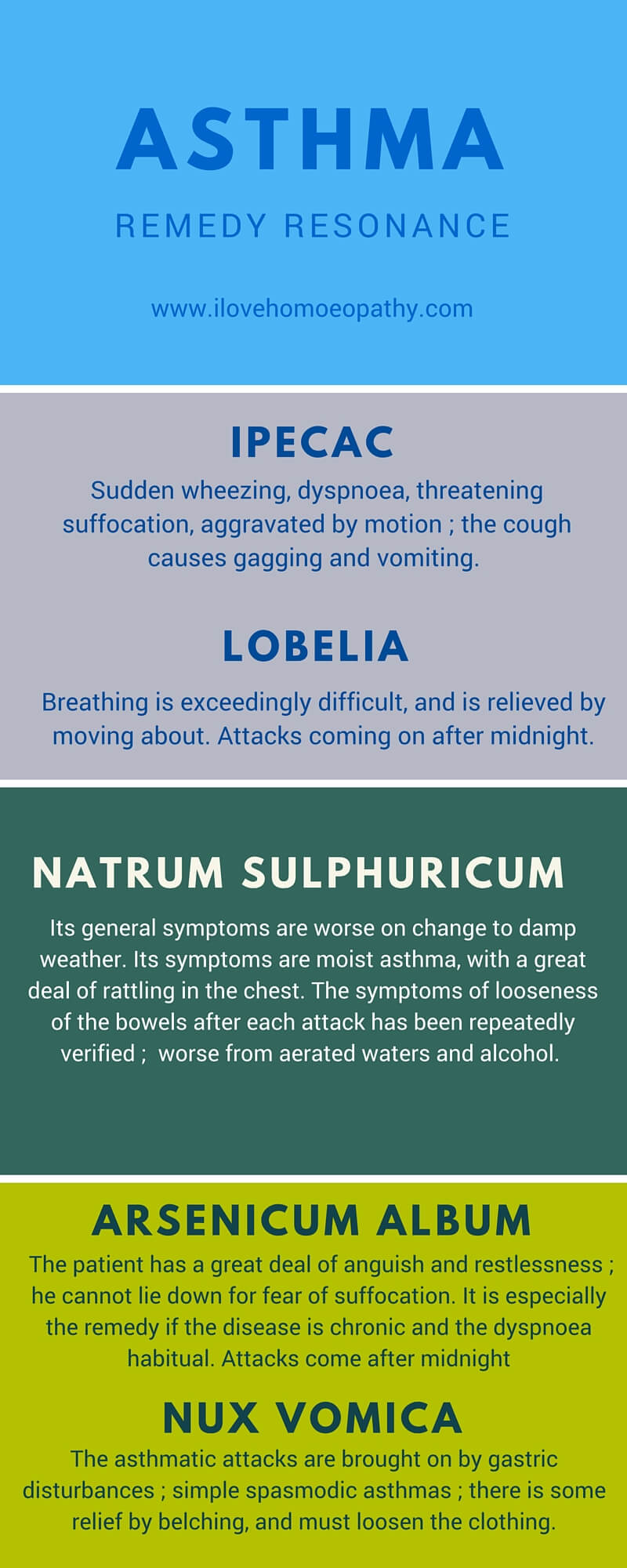
Asthma is a chronic lung disease that inflames and narrows the airways. Asthma causes recurring periods of wheezing (a whistling sound when you breathe), chest tightness, shortness of breath, and coughing. The coughing often occurs at night or early in the morning. This is exactly the reason that Homeopathic remedies work best. Allopathy admits there is no cure for Asthma. We discuss some remedies that work for Asthma. Your homeopath will arrive at the similimum based on your symptoms. Ipecac: This remedy is a closest homeopathic similimum to asthma, especially to the spasmodic variety where the symptoms are great weight and anxiety about the chest ; sudden wheezing, dyspnoea, threatening suffocation, aggravated by motion ; the cough causes gagging and vomiting. The cough is constant, the chest seems full of phlegm, yet none is expectorated, and the extremities are covered with cold perspiration. The expiration is especially difficult ; vomiting when it occurs is apt to relieve the attack. Lobelia: A remedy which one usually classifies with Ipecac, It has the great oppression of the chest and a weak sensation in the chest which seems to come from the epigastrium, where there is a feeling of a lump ; there is nausea, profuse salivation ; the attack is preceded by a prickling sensation through the whole body. It is most useful in bronchial and septic asthmas. The breathing is exceedingly difficult, and is relieved by moving about. Attacks coming on after midnight lead to the use of this remedy. Arsenicum album: Arsenicum has some similarity to Ipecac but the time of attacks is just after midnight. The patient has a great deal of anguish and restlessness ; he cannot lie down for fear of suffocation. It is especially the remedy if the disease is chronic and the dyspnoea habitual. Apis: It has a suffocative feeling, and the patient does not see how he can get another breath, and the Bromine: The patient breathes very deeply as it seems as if he could not get air enough into his lungs. Grindelia robusta The patient on falling asleep ceases to breathe and awakes with a start. Grindelia has been found clinically to benefit humid asthma and acute catarrhal asthmas. Nux vomica. Nux vomica is a useful remedy when the asthmatic attacks are brought on by gastric disturbances ; simple spasmodic asthma ; there is some relief by belching, the patient must loosen the clothing. It must also be thought of in those who drink much coffee or liquor. Irritable bilious temperaments also correspond to the drug. A good symptom calling for Nux is a constricted feeling at the lower part of the chest Where there is much abdominal irritation present with much flatulence, Zingiber is also a remedy for asthma of gastric origin, and the attacks come on toward morning; the patient must sit up ; no anxiety. Carbo vegetabilis also corresponds to the asthma of the aged who are much debilitated ; they are greatly oppressed for breath and are relieved by belching wind. Kali bichromicum. The attacks coming on about three or four o'clock in the morning, compelling the patient to sit up to breathe ; he sits up and bends forward which relieves somewhat, as does also the expectoration of stringy yellow mucus , which is characteristic of the remedy. Kali carbonicum has asthma worse towards morning, with a feeling as if there were no air in the chest. Kali phosphoricum has been successfully used in asthma, especially in the nervous variety. Natrum sulphuricum. This remedy has established a record in curing asthma. Its general symptoms are worse on change to damp weather. Its symptoms are moist asthma, with a great deal of rattling in the chest. The symptoms of looseness of the bowels after each attack has been repeatedly verified ; in one case the patient was worse from aerated waters and alcohol. If symptoms indicating a sycotic taint be present, it will be all the more strongly indicated. The attacks generally come on about 4 or 5 o'clock in the morning with cough and raising of glairy slime ; expectoration greenish and copious. The asthma of hay fever finds one of its remedies in Natrum sulphuricum. Another symptom of Natrum sulphuricum which is characteristic is that the patient must sit up and hold the chest with the hands during an attack. Antimonium tartaricum The great keynote for the remedy is the presence of fine mucous rales throughout the chest, finer and smaller rales than are found under Ipecac, ' With this remedy the chest seems full of phlegm, with inability to expectorate it There is great dyspnoea, the patient must sit up, and there are suffocative attacks coming on as in the potash preparations (and this contains potash) about three o'clock in the morning. There is great difficulty in the expiratory effort. Antimonium tartaricum is especially adapted to the extremes of life, suiting the asthmatic attacks of the aged and the dyspnoea of young children when due to pulmonary affections. The sensation that the patient cannot get air enough is characteristic of the remedy. Blatta orientalis has obtained a good clinical record in acute and chronic asthmas, and is well worthy a trial in obstinate cases.
Remedy Resonance
ASTHMA
KM
Written by
Kartik Murtys
November 15, 2015· 4 min read
Asthma is a chronic lung disease that inflames and narrows the airways. Asthma causes recurring periods of wheezing (a whistling sound when you breathe), chest tightness, shortness of breath, and coughing. The coughing often occurs at night or early in the morning. This is exactly the reason that Ho
Seek urgent care if:
- Severe symptoms should be assessed by a qualified clinician
- Breathing difficulty, chest pain, or neurological symptoms need urgent care
- Do not delay emergency treatment while reading educational content
Educational purpose only. This content does not replace medical advice, diagnosis, or treatment. Please consult a qualified practitioner before starting or stopping any treatment.